Engineered wood doors have become a practical choice for homeowners, builders, and renovation professionals. They combine wood fibers, veneers, or layered panels into a stable door construction. This design can reduce movement caused by changing temperature and humidity. It may also provide a smoother surface for paint or natural wood finishes. Still, performance depends heavily on the core material, edge sealing, and manufacturing quality.
What are the pros and cons of engineered wood doors? This guide examines ten important points, including cost, durability, appearance, insulation, maintenance, and environmental considerations. A well-made door can feel solid, close quietly, and remain attractive for years. A poorly specified model may swell near a damp bathroom or show damage around an unsealed cut edge. Details matter.
The discussion draws on common installation experience, manufacturer specifications, and practical building principles. It also recognizes that no door suits every property. For example, a veneered engineered door may work beautifully in a dry hallway but require extra protection in a humid entryway. Installation accuracy matters just as much as the door slab itself. Small gaps, weak hinges, or incorrect sealing can undermine good materials. Not always. Buyers should compare warranties, moisture ratings, surface finishes, core types, and repair options before choosing. This balanced overview highlights where engineered wood doors offer genuine value, while noting the compromises that are easy to overlook.
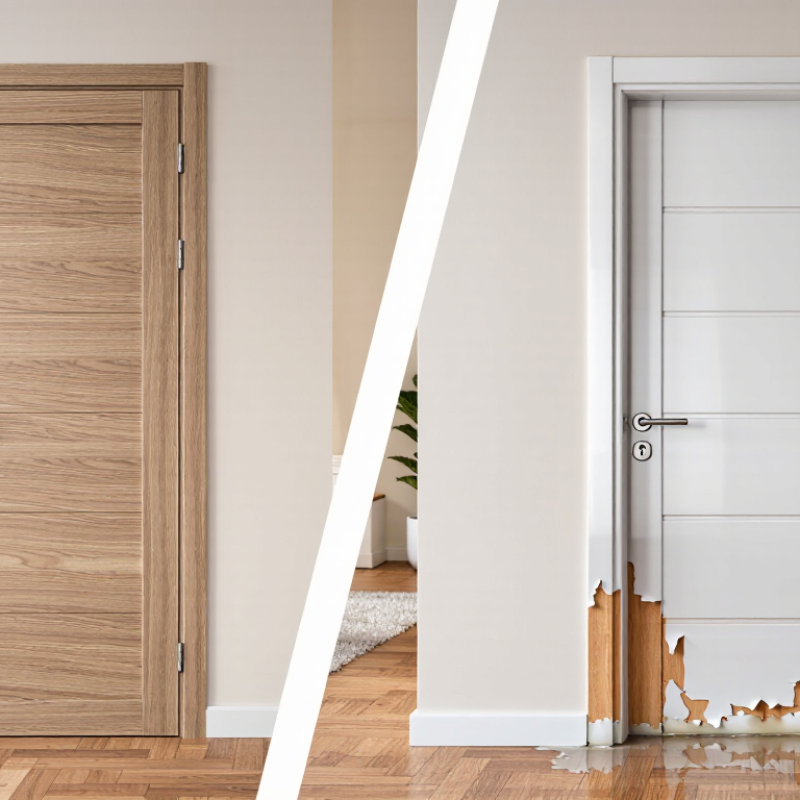
Engineered wood doors are built from several wood layers rather than one solid plank. Manufacturers bond veneers, fibers, or wood strips around a stable core. Pressure and controlled heat create a strong, uniform panel. The door is then cut, sanded, sealed, and finished. This structure helps reduce warping when indoor humidity changes. It also uses wood efficiently and can create consistent sizes. However, quality depends on the core, adhesive, veneer thickness, and edge sealing. A cheap construction may look excellent at first, then reveal swollen edges after moisture exposure. That detail matters.
Tips: Check every edge before buying. Look for complete sealing, even joints, and a firm surface. Ask about moisture resistance and installation requirements. Leave clearance for seasonal movement, especially near kitchens or bathrooms. Avoid trimming too much from the door.
Engineered wood doors offer several practical advantages: stable dimensions, lower material waste, smooth finishes, and dependable performance in ordinary interiors. They are often easier to paint or stain than visibly irregular solid wood. Still, repairs can be difficult if the outer veneer is thin. Deep scratches may expose the core. Some doors also feel less substantial than solid timber.
I once underestimated that difference by judging only the appearance. A heavier door may provide a quieter closing sound, but weight alone does not prove better construction. Compare the core, surface layers, hardware preparation, and warranty terms before choosing.
Engineered Wood Doors: Five Practical Advantages
Engineered wood doors combine real wood fibers, veneers, and stable core materials. Their layered construction offers several benefits for modern homes and commercial spaces.
The first advantage is improved dimensional stability. These doors are less likely to warp when indoor humidity changes. That matters in kitchens, bathrooms, and coastal homes. The second is consistent appearance. Factory-controlled production creates smoother surfaces and more uniform grain patterns. The third benefit is design flexibility. Engineered doors can accept paint, stain, glass panels, and different edge profiles. They fit both traditional and contemporary interiors.
Another advantage is efficient material use. Manufacturers can create strong doors from carefully arranged wood layers. This may reduce waste compared with some solid wood methods. The fourth benefit is reliable performance. A properly built door can provide good sound reduction, privacy, and daily durability. The fifth is easier maintenance. Minor scratches can often be repaired, although deep damage may expose the core. That limitation should not be ignored. Engineered wood is stable, but it is not completely moisture-proof.
Tips: Check the door’s core, veneer thickness, edge sealing, and moisture rating before purchase. Measure the frame carefully. A beautiful door can still perform poorly when installation is rushed. In my experience, sealing exposed edges is one small step people often forget. It can prevent swelling near floors and sinks. Always ask for maintenance instructions and inspect samples in natural light.
Engineered wood doors are made from bonded wood fibers, veneers, or layers. The chart uses a qualitative 0–5 scale to show the typical strength of each characteristic; actual performance depends on construction, finish, installation, and exposure conditions.
The five main advantages are dimensional stability, efficient use of wood resources, design flexibility, consistent surface quality, and good value. Key drawbacks include moisture sensitivity, dependence on surface finish, limited repair options for some constructions, and less natural grain variation than solid wood.
Engineered wood doors offer good stability and consistent surfaces, but their disadvantages deserve close attention. Their performance depends heavily on core construction, edge sealing, and installation quality. In my experience, a well-made door can perform for years, while a poorly sealed one may deteriorate quickly.
Moisture is the first major concern. Water can enter through unfinished edges, screw holes, or damaged veneers. Swelling may then cause rubbing, sticking, or uneven gaps. Water is the enemy. Bathrooms, basements, and exterior openings require careful sealing and regular inspection.
A second problem is limited repairability. Deep scratches, chipped edges, or swollen areas may expose the inner core. Unlike solid timber, this damage often cannot be sanded deeply without making the surface worse.
A third disadvantage is surface vulnerability. Thin decorative layers can peel or blister under heat, impact, or excessive humidity.
A fourth concern is quality variation. Some doors use durable moisture-resistant cores, while cheaper products may feel light and weak around the hinge area.
The fifth issue involves environmental and indoor-air considerations. Adhesives and coatings can release emissions, especially in poorly ventilated rooms, so verified low-emission documentation matters.
Hardware placement also requires precision. Loose hinges can quickly enlarge the engineered core. Edges matter most. I have seen installers focus on the face and overlook the bottom edge, where cleaning water quietly causes damage.
These doors are practical, but they are not flawless.
When comparing door materials, engineered wood sits between solid timber and synthetic products. Its layered core resists warping better than many solid-wood slabs. That matters in hallways near kitchens or changing seasonal humidity. The surface can accept paint, veneer, or laminate. It often feels warmer than steel or plastic. A real advantage.
Compared with solid wood, engineered doors usually cost less and maintain more consistent dimensions. They can provide good sound reduction when their core is dense and the frame is sealed. However, damaged edges may expose vulnerable layers. Repairs are not always invisible.
Solid wood allows deeper sanding and can last for decades with careful maintenance. Yet it may swell, shrink, or develop cracks when moisture control is poor.
Fiberglass and steel doors generally handle rain better, especially at exposed entrances. Steel offers stronger impact resistance, while fiberglass needs less repainting. Engineered wood can look more residential and match interior trim more easily. It is not the best choice for every doorway. Check the moisture rating, core construction, fire rating, and warranty terms before ordering. For a bathroom or unprotected exterior opening, I would hesitate unless installation details are excellent. Small gaps around the frame can defeat a good door. That is easy to underestimate.
Choosing an engineered wood door starts with climate, not appearance.
The USDA Forest Products Laboratory’s Wood Handbook explains that moisture changes cause wood movement, while engineered construction can improve dimensional stability. That matters near bathrooms, kitchens, and rainy entrances. Still, the core must be checked carefully. Some doors resist warping well, but poorly sealed edges can swell quickly.
Look for a moisture-resistant core, durable veneer, and sealed top and bottom edges. Check the door’s tested air leakage, water resistance, and structural performance under applicable WDMA or NAFS standards. These details matter more than a smooth showroom finish.
Acoustic needs also guide the choice. A heavier, solid-core design usually blocks more sound than a lightweight hollow-core model. It costs more.
Sustainability requires closer questions.
The FAO’s Global Forest Resources Assessment 2020 reports that forests cover about 31% of global land and that 420 million hectares disappeared between 1990 and 2020. Engineered wood can use veneers, fibers, and smaller wood pieces efficiently, but that does not automatically make every door environmentally responsible. Ask for legal timber sourcing, recycled content, low-emission adhesive information, and an environmental product declaration when available. I would not trust a cheap door without these records. My own preference would change after inspecting the edge seals, hinge reinforcement, and repair options.
The overlooked detail is often the expensive one.
They use veneers, wood fibers, or strips around a stable core. Heat and pressure bond the layers. The panel is then cut, sanded, sealed, and finished.
Their layered structure handles changing indoor humidity better than many solid planks. This helps in kitchens, bathrooms, and coastal homes. They are not completely moisture-proof.
Factory production creates smooth surfaces and consistent grain patterns. They can receive paint, stain, glass panels, or different edge profiles. Inspect samples in natural light.
Layered construction can use wood more efficiently than some solid-door methods. Carefully arranged layers may reduce material waste. Manufacturing quality still matters.
A properly built door can improve privacy and reduce ordinary household sounds. A heavier door may close more quietly. Weight alone proves little.
Check the core, veneer thickness, edge sealing, and moisture rating. Look for even joints and a firm surface. Inspect every edge.
Minor scratches can often be repaired with suitable finishing materials. Deep scratches may expose the core. Thin veneers leave less room for sanding.
Measure the frame carefully and follow the required clearances. Leave room for seasonal movement near sinks or bathrooms. Avoid trimming too much from the door.
Not always. They often offer stable dimensions and smooth finishes. Some feel less substantial, and poor construction may swell after moisture exposure. I once judged one by appearance alone. That was a mistake.
Engineered wood doors are made by combining layers of wood fibers, veneers, or other wood-based materials to create a stable and attractive door structure. What are the pros and cons of engineered wood doors? Their main advantages include improved resistance to warping, consistent quality, flexible design options, easier maintenance, and often a lower cost than solid wood. They can also offer reliable insulation and a natural wood appearance while using materials efficiently.
However, engineered wood doors may have limited repairability if their surface is severely damaged, and some products can be sensitive to prolonged moisture or poor installation. Their appearance and durability may vary depending on construction quality, and they may not provide the same weight or prestige as solid wood. Compared with metal, fiberglass, and plastic doors, engineered wood offers a balanced combination of warmth, style, stability, and value. Buyers should consider climate, location, budget, security, insulation, maintenance needs, finish quality, and expected lifespan before making a choice.

Weston Door