Choosing a finish for natural oak is not merely a color decision. It affects grain clarity, touch, maintenance, and long-term stability. So, what is the best finish for a natural oak door? The honest answer depends on location, traffic, sunlight, and the appearance you want.
The USDA Forest Products Laboratory explains in its Wood Handbook: Wood as an Engineering Material (FPL-GTR-282, 2021) that wood continually exchanges moisture with surrounding air. Oak doors can therefore react to seasonal humidity changes. A suitable finish slows moisture movement, but it does not stop wood from moving. That detail matters.
Not every attractive finish performs equally well. Clear oil can deepen oak’s honey color and highlight open pores. Water-based polyurethane usually preserves a paler appearance and dries faster. Hardwax oil offers a natural, repairable surface, but it may need more frequent care near handles and thresholds. The Architectural Woodwork Standards also emphasizes proper surface preparation, even sheen, and compatibility between coatings and wood substrates.
This guide compares ten popular finishes for natural oak doors. It considers durability, color change, application effort, drying time, VOC concerns, and maintenance. Real workshop conditions are rarely perfect. Dust appears. Edges absorb more product. Some finishes look excellent on a sample board but disappoint across a full door. That is worth admitting.
Test first. Always.
We will also examine how direct sunlight, wet footwear, pets, and frequent hand contact affect each option. The best finish is not automatically the hardest one. It is the finish that suits the door’s environment and the owner’s willingness to maintain it.
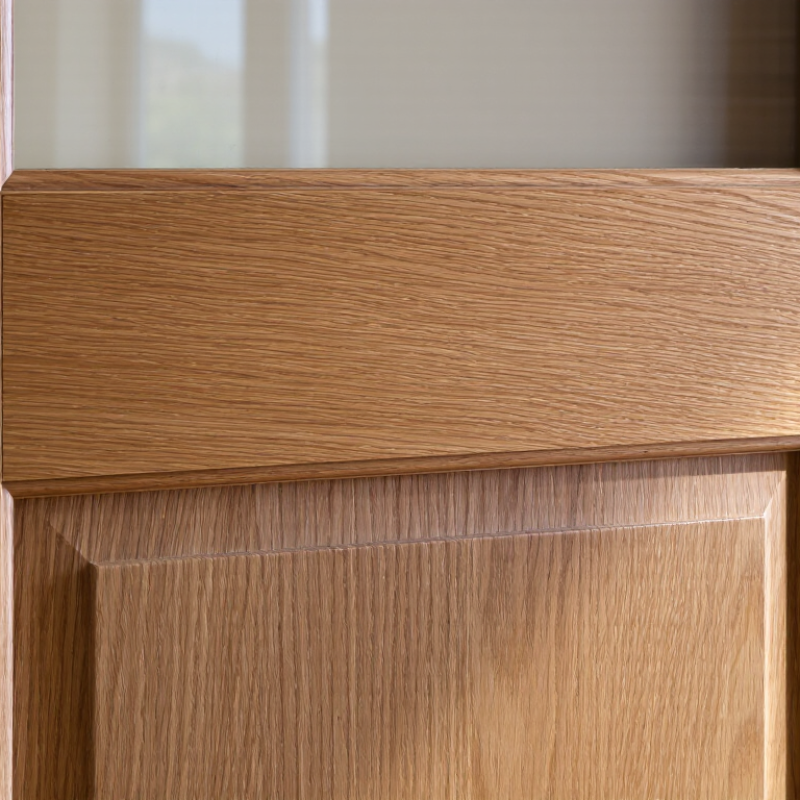
For a natural oak door, the best finish depends on touch, moisture, sunlight, and desired color. Oak has open pores, so preparation strongly affects the final appearance. Sand evenly, remove dust, and test every finish on an unseen edge.
Ten practical choices include penetrating oil, tung-style oil, Danish-style oil, hardwax oil, clear paste wax, tinted wax, oil-based varnish, water-based varnish, clear lacquer, and oak stain. Penetrating oils enrich the grain and are easy to refresh, but they offer limited surface protection. Hardwax oil feels warm and natural while resisting everyday marks. Wax feels smooth. It scratches more easily. Oil-based varnish gives stronger protection and adds amber warmth. Water-based varnish stays clearer, though it may raise the grain slightly. Lacquer dries quickly and looks refined, but application needs careful ventilation and even technique. Stain changes the oak’s color rather than protecting it. Apply a compatible clear coat afterward.
I once used a dark stain without conditioning the wood. The door developed uneven patches near the end grain. That mistake changed my process. I now test two coats on scrap oak first. Apply thin coats, respect drying times, and lightly abrade between coats when instructions require it. Exterior doors need finishes rated for outdoor exposure, while interior doors usually benefit from lower-odor water-based products. Wipe away oil excess before it becomes sticky. Avoid heavy wax over uncured varnish, because adhesion can fail. Pay special attention to the bottom edge and handle area, where moisture and skin oils collect.
Comparative suitability scores for common oak-door finishes, based on typical durability, water resistance, natural appearance, and ease of maintenance.
Hardwax oil and water-based varnish rank highly because they preserve oak’s appearance while offering strong everyday protection. Oil-based polyurethane provides excellent durability but creates a more noticeable film. Wax and linseed oil maintain a natural look but generally require more frequent maintenance and offer less resistance to moisture.
Scores use a 0–100 comparative index based on commonly documented finish characteristics. Actual performance depends on preparation, coating thickness, curing conditions, and indoor exposure.
What Is the Best Finish for a Natural Oak Door Top 10?
For a natural oak door, abrasion testing matters more than glossy appearance. ASTM D4060 measures coating wear with a rotating abrasive wheel. Results usually report mass loss or wear index after a defined number of cycles. Lower loss indicates better resistance. A fair comparison should use identical wheels, loads, cycle counts, and failure points. My practical top ten are moisture-cure urethane, conversion varnish, two-component waterborne urethane, solvent-based polyurethane, one-component waterborne polyurethane, catalyzed lacquer, epoxy, acrylic lacquer, hardwax oil, and penetrating oil.
The strongest candidates usually build a continuous film over oak pores. Moisture-cure urethane and conversion varnish often deserve the highest positions. Two-component waterborne urethane can also perform well, while hardwax oil and penetrating oil preserve touch and grain better than abrasion resistance. A 1,000-cycle ASTM D4060 test using a CS-10 wheel and 1,000-gram load can expose meaningful differences. However, these settings are not a universal service prediction. Door edges, grit, keys, and repeated hand contact create different damage.
Oak itself complicates the comparison. The USDA Forest Products Laboratory’s Wood Handbook, FPL-GTR-282, reports white oak at roughly 0.60 specific gravity on an oven-dry basis. Dense wood does not guarantee a durable finish. Surface sanding, moisture content, film thickness, and curing time remain critical. No test is perfect. My ranking is provisional. Real doors may reverse it, especially when maintenance and repairability matter more than peak cycle performance. A careful test report should publish specimen preparation, coating thickness, wheel type, load, cycles, and wear endpoint.
Comparative performance guide for natural oak doors
| Rank | Finish Type | Typical ASTM D4060 Mass Loss (mg / 1,000 cycles) |
Abrasion Resistance | Typical Drying / Cure Time | Appearance on Natural Oak | Best Use |
|---|---|---|---|---|---|---|
| 1 | Two-component waterborne polyurethane | 20–45 | Excellent | 1–3 days | Clear to slightly warm; low yellowing | High-traffic exterior-protected doors |
| 2 | Solvent-borne polyurethane | 25–55 | Excellent | 3–7 days | Rich amber tone; emphasizes grain | Interior doors and heavy-use areas |
| 3 | Conversion varnish | 30–65 | Excellent | 3–7 days | Smooth, hard film; moderate warmth | Factory-finished interior doors |
| 4 | Waterborne polyurethane | 40–80 | Very good | 2–5 days | Very clear; preserves pale oak color | Modern interiors and light-colored oak |
| 5 | Acid-catalyzed lacquer | 45–90 | Very good | 2–5 days | Thin, smooth film with moderate ambering | Interior doors with a refined finish |
| 6 | Oil-modified polyurethane | 55–110 | Good | 3–7 days | Warm amber color; enhances oak depth | Traditional interior applications |
| 7 | Hardwax oil | 90–180 | Good | 5–14 days | Natural matte or satin appearance | Low-sheen doors needing spot repair |
| 8 | Danish oil | 140–260 | Moderate | 3–7 days | Satin, warm, and grain-enhancing | Decorative interior doors with light use |
| 9 | Shellac | 180–350 | Moderate to limited | 1–3 days | Clear to amber; traditional hand-rubbed look | Low-wear interior and restoration work |
| 10 | Paste wax | 250–500 | Limited | 1–3 days | Soft satin sheen; natural tactile feel | Decorative doors and maintenance coats |
For a natural oak door, finish hardness should be measured, not guessed.
ASTM D3363 evaluates a cured coating with pencils from 9B to 9H. Higher H ratings indicate greater resistance to a controlled scratch. A 3H or 4H result can suit interior doors, while 5H may offer stronger protection against keys and daily contact. However, ASTM D3363 is comparative. It does not define the “best” finish for every oak door.
The USDA Forest Products Laboratory reports approximate Janka hardness values of 1,290 lbf for red oak and 1,350 lbf for white oak.
Oak is already durable, but its open grain can expose uneven coating thickness. A hard film may still chip at sharp edges. Surface preparation, curing time, and film thickness affect the pencil result. This is where practice becomes less tidy. A door can pass a 4H test yet show dents from impact.
Tips:
Test the actual finish on an oak sample. Sand it like the door. Apply the same number of coats, then allow full curing. Test three areas, including a grain ridge and a flat section. Record the lowest rating. ASTM D3363-22 recommends controlled pencil angle and pressure, so informal key tests are poor substitutes.
A satin film often hides minor marks better than a high-gloss film. Harder is not always better. My own cautious preference is a well-cured 3H–4H finish with careful edge sealing, rather than chasing an impressive rating.
For a natural oak door, the best finish depends on exposure, not appearance alone. A sheltered entrance may suit a clear exterior coating with UV absorbers. A fully exposed door needs stronger protection against sunlight, rain, and repeated swelling. EN 927 testing helps compare these demands through weathering, water permeability, and coating durability.
Pigmented finishes usually protect oak better than completely clear products. The pigment limits UV damage, while the coating slows moisture movement through the timber. Light stains preserve visible grain. Opaque finishes offer more consistent colour retention. Clear coatings look elegant, but they can reveal greying, cracking, and patchy wear sooner. That is not always obvious during installation.
The coating system matters as much as the product type. Seal all faces, edges, and especially the lower door end. Oak contains natural extractives, so early discolouration can occur beneath pale finishes. Follow the tested film thickness and preparation method. A thicker coat is not automatically safer.
Real doors are not test panels.
EN 927 exposure categories provide useful guidance, but site conditions still matter. A south-facing door under a shallow canopy may experience harsher UV exposure than a fully exposed north-facing door. I would inspect the finish twice yearly for hairline cracks, dull patches, and open end grain. Maintenance is sometimes the overlooked “top finish.” A perfect specification cannot compensate for neglected water entry.
Choosing the best finish for a natural oak door starts with the coating’s VOC information. Directive 2004/42/EC sets maximum VOC limits for decorative paints, varnishes, and woodstains sold in the EU. A clear finish should identify its product category and applicable limit on the label or technical documentation. Do not assume “low odour” means low VOC. Odour is an unreliable warning.
For oak, a water-based clear varnish may preserve a lighter appearance, while some solvent-based finishes deepen the grain. Check the ready-to-use VOC value, not only the product’s wet-film description.
The Safety Data Sheet can provide supporting information, but the container label should remain your first verification point. The directive controls coating content, not every exposure during sanding, spraying, or curing. Ventilation still matters. So does patience.
Tips: Test the finish on an offcut of the same oak. Look for darkening, raised grain, and uneven sheen after full curing. Keep the door in a ventilated area, and follow the manufacturer’s drying time. A compliant coating can still fail visually if applied too heavily. I have seen “perfect” samples change tone after several days; that is worth questioning. Also verify whether the door is interior or exterior, because the correct coating category and performance requirements may differ. Choose documented compliance over vague claims.
The best choice depends on moisture, sunlight, touch, and desired color. Hardwax oil feels natural and resists everyday marks. For stronger protection, choose a durable film-forming finish.
Penetrating oil enriches the grain without creating a heavy surface film. Hardwax oil also keeps a warm, tactile feel. Protection remains limited.
Wax feels smooth but scratches more easily. It suits lightly handled interior doors better. Not for heavy wear.
Stain changes the wood’s color but provides little protection. Apply a compatible clear coat afterward. Always test the color on scrap oak.
Sand evenly and remove every trace of dust. Test two coats on an unseen edge or scrap piece. Oak’s open pores reveal preparation mistakes quickly.
Tough film finishes usually resist abrasion better than oils or waxes. Moisture-cure urethane and conversion varnish often perform strongly. The ranking is not absolute.
They compare finishes under controlled wheels, loads, and cycle counts. Real doors face grit, keys, edges, and repeated hand contact. The test cannot predict everything.
Staining unconditioned oak can create dark patches near end grain. Heavy wax over uncured varnish may fail to adhere. I learned this the hard way.
Use a finish rated for outdoor exposure. Protect the bottom edge, where moisture collects. Recheck it often.
Apply thin coats and respect the stated drying times. Lightly abrade between coats when required. Wipe away excess oil before it turns sticky.
Choosing the right coating depends on how the natural oak door will be used, exposed, and maintained. This guide compares ten finish options, including oils, waxes, varnishes, lacquers, and stains, with attention to appearance, durability, moisture resistance, and ease of renewal. It asks, “What is the best finish for a natural oak door?” rather than assuming one product suits every setting.
Performance is assessed through ASTM D4060 wear-resistance testing and ASTM D3363 pencil-hardness ratings, helping readers understand how well each finish withstands abrasion and surface marking. For exterior doors, the comparison also considers EN 927 weathering and UV-exposure classes, while VOC safety is reviewed against the coating limits established by EU Directive 2004/42/EC. The result is a practical framework for selecting a finish that protects oak, preserves its natural character, and matches the door’s environment, expected traffic, and maintenance requirements.

Weston Door